
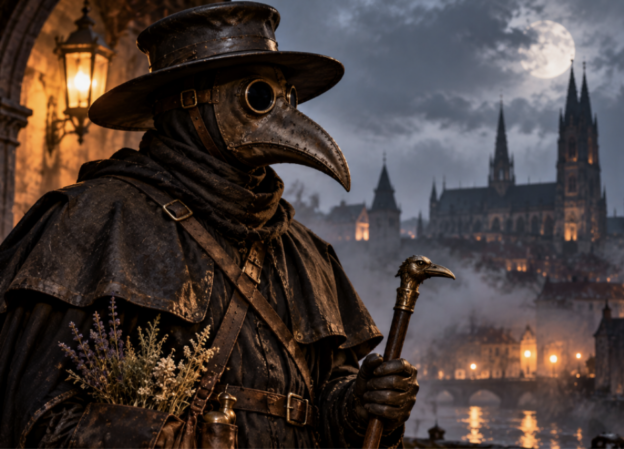
By Chelsea: Few historical figures are as instantly recognisable—or as wonderfully unsettling—as the plague doctor.
With a birdlike mask, hollow black eye lenses, and a long coat that seems tailor-made for a midnight funeral, this peculiar figure looks less like a physician and more like an omen that has learned to walk upright.
It is easy to understand why the image continues to fascinate us. Plague doctors appear in gothic artwork, horror films, occult-inspired fashion, and modern folklore, occupying that deliciously uncomfortable space where history meets the macabre.
Yet beneath the sinister appearance lies a story of medical desperation, misunderstood science, and humanity’s enduring struggle against the invisible forces that threaten it.
And, naturally, a rather unfortunate amount of perfume.
When Medicine Met Mystery
To understand the plague doctor’s distinctive appearance, we must travel back to a time when physicians lacked the scientific knowledge needed to explain how infectious diseases spread.
The Black Death devastated Europe during the fourteenth century, killing millions of people. Later plague outbreaks continued to haunt European cities, leaving communities searching for ways to protect themselves from a disease that seemed capable of striking without warning.
Medical knowledge was limited, and many physicians subscribed to the theory of miasma: the belief that illnesses could be caused by corrupted or poisonous air. Bad smells were often considered evidence of dangerous atmospheric conditions.
If the air itself was believed to be the enemy, covering one’s nose with something fragrant seemed perfectly reasonable.
Enter the beak.
The famous protective outfit is often associated with Charles de Lorme, a French physician who is traditionally credited with developing a specialised costume in the early seventeenth century. His ensemble reportedly included a long outer garment, gloves, boots, a hat, and a mask featuring a prominent curved nose.
The beak could be filled with aromatic materials such as herbs, spices, dried flowers, and other scented substances. These ingredients were intended to filter or neutralise supposedly harmful air before the physician breathed it.
From a modern medical perspective, the approach was ineffective against the actual causes of plague transmission. However, within the medical understanding of the period, it represented an attempt to create a protective barrier against an invisible danger.
Sometimes, the difference between a medical breakthrough and a historical footnote is simply understanding what the problem actually is.
The Real History Is Stranger Than the Legend
One of the most persistent misconceptions about plague doctors is that they all wore the familiar beaked mask during the Black Death.
They did not.
The major fourteenth-century pandemic occurred centuries before the protective costume associated with de Lorme. Physicians treating plague patients wore various forms of clothing, and the complete beaked ensemble was never universal among practitioners.
The image we recognise today became famous partly because it is so visually distinctive. Artists, storytellers, costume designers, and horror creators have helped transform it into the defining symbol of historical plague medicine.

There is another fascinating detail: the beaked mask was not simply a bizarre fashion choice. It reflected the medical beliefs, fears, and practical concerns of its time.
The outfit was an attempt at protection, even if its underlying theory was flawed.
Today, we understand that plague is caused by Yersinia pestis, a bacterium commonly transmitted through infected fleas. Depending on the form of the disease, transmission can also occur through other routes, including respiratory droplets in cases of pneumonic plague.
Aromatic herbs cannot reliably prevent these forms of infection.
Nevertheless, the costume remains a remarkable example of how cultural beliefs and scientific understanding influence the appearance and practice of medicine.
Why the Plague Doctor Still Haunts Our Imagination
There is something uniquely disturbing about a face that refuses to behave like a face.
The plague doctor’s mask conceals the wearer’s expressions. The dark lenses offer no reassuring eye contact, while the elongated beak distorts the familiar human silhouette into something almost animalistic.
We cannot read the person underneath.
That ambiguity makes the figure an ideal subject for horror and gothic storytelling. The plague doctor can represent a healer, a harbinger of death, a mysterious stranger, or an observer who has arrived just as something terrible is about to happen.
The image also carries powerful historical associations. It evokes crowded streets, quarantined communities, candlelit sickrooms, and a period when an ordinary cough could inspire genuine terror.
Modern audiences may be drawn to the mask because it gives a visible shape to an invisible threat.
Disease itself cannot be seen with the naked eye, but the beaked figure transforms that uncertainty into something tangible.
It is fear made wearable.
And, from a costume designer’s perspective, it is difficult to improve upon a face that looks like a raven has taken up medicine.
Between History and the Macabre
The plague doctor has gradually moved beyond historical medicine into the worlds of gothic fashion, symbolism, art, and contemporary folklore.
Its appearance invites associations with mortality, transformation, mystery, and the fragile boundary between healing and harm.
In dark fantasy, the figure often becomes a keeper of secrets or a messenger between life and death.
These interpretations are modern cultural associations rather than evidence of a hidden supernatural origin.
Still, their appeal is understandable. The mask carries centuries of fear and fascination in a single recognisable silhouette.
It also reminds us that history is not merely a collection of dates and events. It is the story of people attempting to survive circumstances they could not fully comprehend.
The physicians who treated plague patients did not possess today’s knowledge of bacteria, modern protective equipment, or effective antimicrobial treatments.
They worked within the limitations of their era, sometimes risking their own lives in the process.
Their beaked masks were not magical shields, but they remain enduring symbols of humanity’s determination to confront danger.
Perhaps that is the real secret behind their lasting appeal.
The plague doctor stands at the intersection of science and superstition, compassion and fear, life and death.
Its strange silhouette reminds us that the past was filled with people trying to make sense of an uncertain world.
And while we may no longer need a beak stuffed with herbs to understand infectious disease, we have not lost our fascination with the mysteries that once frightened our ancestors.
Some historical images simply refuse to disappear.
The plague doctor, with its shadowed eyes and unmistakable profile, seems perfectly content to remain one of them.

Latest posts by Chelsea (see all)
- The Dark Allure Of The Plague Doctor: Behind The Beak - October 21, 2026
- Marked By Mystery: Seer Signs, Moles, And Witch Folklore - October 21, 2026
- Belladonna: The Dark Secrets Of Deadly Nightshade - October 13, 2026