
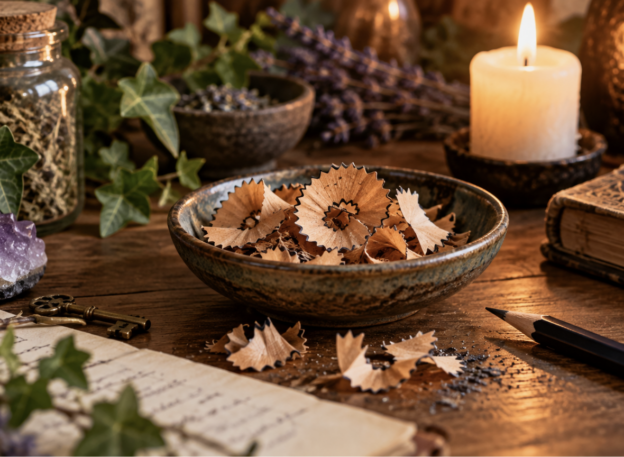
By Chelsea:Witches have never been particularly impressed by the idea that an ingredient needs to come in a velvet pouch with a Latin name to be magical.
Give a witch a kitchen drawer, a handful of herbs, some string, an old key, and a slightly suspicious-looking jar, and she’ll probably have a spell going before dinner.
Which brings us to something remarkably ordinary: pencil shavings.
Those tiny curls of wood are easy to overlook, but in traditional and folk-inspired witchcraft, ordinary household objects can become powerful symbols when deliberately incorporated into ritual. Pencil shavings carry an especially interesting symbolism because they are created through an act of sharpening, cutting, stripping away, and transformation.
And honestly, isn’t that what half of witchcraft is about?
Getting rid of things that have been annoying you?
The Magic of the Blade
Before the pencil becomes useful, it must be sharpened.
Something is removed so that something else can become more effective.
That makes pencil shavings a fitting ingredient for workings involving banishing, purification, clarity, breaking stagnation, and personal transformation.
The discarded wood can represent old habits, confusion, attachments, limiting beliefs, or circumstances that have become dull and unproductive.
In sympathetic magic, the physical action becomes part of the symbolic language of the spell.
As the pencil is sharpened, visualise what you are removing from your life.
Let the shavings fall.
With each curl of wood, imagine another layer of resistance being stripped away.
The goal isn’t destruction for destruction’s sake. It is refinement.
A dull point doesn’t write clearly.
Neither does a scattered intention.
Wood, Memory, and the Household Witch
Wood has deep associations across European folk traditions with trees, ancestral landscapes, protection, thresholds, and the natural world. Different woods have different folklore surrounding them, and the species of wood used in a pencil can vary.
For a witch working traditionally, that can make the pencil itself an interesting object to examine.
What kind of wood is it?
Where did it come from?
What does that tree traditionally symbolise?
You don’t necessarily need to know the answer to work symbolically, but knowing the material can deepen your relationship with the ritual.
The modern pencil may seem completely mundane, but witchcraft has always had a talent for finding the extraordinary hiding inside the ordinary.
Spells of Uncrossing and Release
Pencil shavings can be particularly appropriate in rituals centred around release.
Write the situation, habit, fear, or attachment you want to leave behind on a piece of paper.
Then sharpen the pencil over the paper.
As the shavings accumulate, visualise the unwanted influence being cut down and reduced.
You might place the shavings into a small dish or spell container as a representation of what has been removed.
When the ritual is complete, dispose of them according to your magical tradition.
Some practitioners may choose to bury biodegradable materials, scatter appropriate natural materials, or simply throw them away while consciously declaring the working finished.
The important part is the symbolism and intention—not whether you perform the ritual while standing dramatically on a cliff during a thunderstorm.
Although, admittedly, that would look fantastic.
Drawing the Line
There is another fascinating use for pencil shavings: boundaries.
A line drawn with a pencil is still a line.
In magical practice, boundaries matter.

You can use a pencil to draw a symbolic circle, boundary, sigil, or protective mark. The resulting shavings can then become part of the ritual itself—the material removed while creating your protective boundary.
This creates an interesting magical paradox:
What was discarded becomes part of the protection.
Something removed from the object becomes useful in the working.
That is a powerful metaphor for transformation.
The Magic Is in the Meaning
Pencil shavings aren’t inherently evil, cursed, or secretly plotting against you from the bottom of your desk drawer.
Their usefulness comes from correspondence, symbolism, intention, and ritual context.
Traditional witchcraft frequently works with precisely this kind of relationship between ordinary materials and magical meaning.
A pencil becomes a tool of creation.
Sharpening becomes an act of removal.
The shavings become the physical evidence of transformation.
And suddenly, something you were about to sweep into the trash has become part of a ritual about becoming sharper, clearer, stronger, and more deliberate.
Perhaps that’s one of the oldest lessons in witchcraft:
Nothing is necessarily useless. Sometimes you simply haven’t discovered its purpose yet.

Latest posts by Chelsea (see all)
- The Dark Allure Of The Plague Doctor: Behind The Beak - October 21, 2026
- Marked By Mystery: Seer Signs, Moles, And Witch Folklore - October 21, 2026
- Belladonna: The Dark Secrets Of Deadly Nightshade - October 13, 2026